Notion AI and ChatGPT Business can both help a team find answers across company information. That makes them look increasingly similar on a feature checklist, especially as both products connect to sources beyond their own interface.
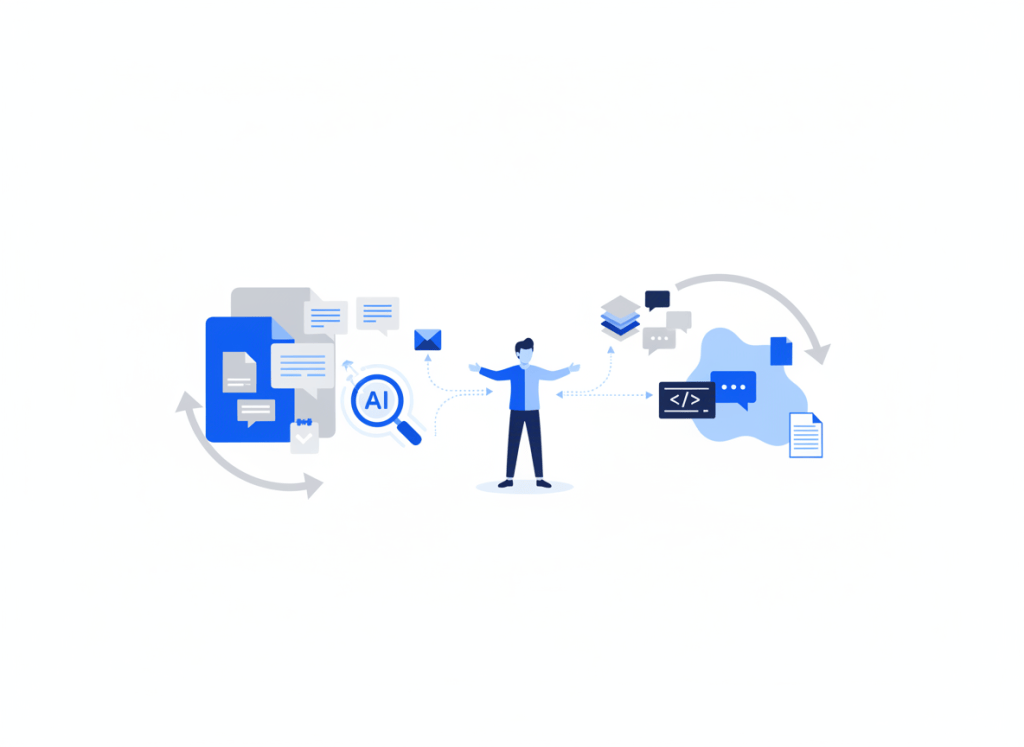
But the more useful distinction is architectural. Notion AI starts from a workspace where knowledge and work can already live together. ChatGPT Business starts from a general AI workspace and can bring information in from multiple connected systems.
For a small team, the decision is less about which chatbot gives a better isolated answer and more about where company knowledge should be found, maintained, and turned into work.
The short version
Notion AI makes the strongest case when Notion is already the team’s operating workspace: docs, project context, meeting notes, databases, and internal knowledge are maintained there. ChatGPT Business makes more sense when the team wants a broader AI work environment and its useful context is distributed across several services.
The overlap is real, so paying for both should not be automatic. Start by deciding whether your bigger problem is organizing knowledge where work happens or bringing scattered knowledge to a general-purpose AI assistant.
Notion AI vs ChatGPT Business at a glance
| Decision factor | Notion AI | ChatGPT Business |
|---|---|---|
| Starting point | Workspace, docs, databases and projects | General AI workspace |
| Knowledge model | Search and work with Notion plus supported connected sources | Bring context from supported connected apps into ChatGPT |
| Best fit | Teams already centering work and knowledge in Notion | Teams whose knowledge is spread across multiple systems and that want broader AI workflows |
| Published annual-billing price | Business: $20 per member/month | Business: $20 per user/month |
| Main reason to choose | Keep AI close to structured team knowledge and ongoing work | Use company context inside a broader general-purpose AI environment |
Pricing and product packaging can change. The figures above reflect published annual-billing prices at the time of writing, so confirm current terms before purchasing.
Notion AI is strongest when Notion is already the source of context
The advantage of Notion AI is not simply that it can answer questions. It operates inside a system where teams may already maintain project pages, decisions, meeting notes, databases, policies, and documentation.
That reduces the distance between finding information and acting on it. A person can search for context, open the underlying page, update the source, and continue working without treating AI as a separate destination.
Notion has also expanded search beyond the workspace through supported connected apps. That weakens the old assumption that choosing Notion AI means searching only Notion content.
The limitation is equally important: this model works best when the team actually maintains useful information in Notion. AI cannot compensate for an abandoned wiki, inconsistent project pages, or important decisions that never make it into the workspace.
ChatGPT Business is broader than company search
ChatGPT Business approaches the problem from the other direction. Company information can become context for a general AI environment that is also used for analysis, writing, research, coding, brainstorming, and other knowledge work.
Supported connections can bring information from services such as Google Workspace, Slack, GitHub, and Microsoft 365 into relevant workflows. For a team whose knowledge is already distributed across several systems, that can be more natural than trying to move everything into a single documentation platform first.
This broader scope is also why the comparison should not be reduced to search quality. A team may justify ChatGPT Business because it wants a general AI work layer, with company knowledge being one source of context rather than the entire product.
Where your knowledge lives matters more than the feature list
Imagine two small teams paying the same headline price for an AI plan.
Team A already runs projects, meeting notes, documentation, and decisions in Notion. Adding AI inside that environment may remove friction because the source material and the resulting work stay close together.
Team B uses Google Drive for documents, Slack for discussion, GitHub for technical work, and several other services. Its problem is not a lack of a central Notion workspace. It wants an AI layer that can work across information that will probably remain distributed.
Those teams can reasonably choose different tools even if the products appear similar in a comparison table.
Do not pay twice for the same vague promise
“AI that knows your company” is becoming a feature across productivity software. That creates a new form of tool overlap: several subscriptions may offer search, summaries, writing, connected knowledge, and assistants at the same time.
Before paying for both Notion AI and ChatGPT Business, assign each product a specific job. If you cannot describe the distinct recurring workflow each one owns, the stack may be duplicating capability rather than adding value.
Our AI productivity stack audit provides a practical framework for finding this overlap. If you are building the stack from scratch, start with the broader guide to building an AI productivity stack without tool overload.
What if Notion is also your project manager?
The decision becomes more consequential when Notion is not just a wiki but part of the team’s project system. In that case, knowledge search sits next to databases, tasks, project pages, meeting notes, and workflows.
If you are still deciding whether Notion should occupy that central role, our Notion vs ClickUp comparison for small teams examines the underlying workspace choice before AI is added on top.
A better way to evaluate both tools
Instead of testing both products with generic prompts, collect five real questions your team repeatedly asks. Examples might include finding the latest project decision, locating a customer requirement, summarizing a long internal discussion, identifying the source behind a policy, or turning existing context into a new deliverable.
Then evaluate the whole path: where the answer comes from, whether the source is visible, how much context must be supplied manually, and what happens after the answer is produced.
That test reveals something a feature checklist cannot: whether AI is sitting in the natural path of your team’s work or forcing the team to build a new one around it.
The bottom line
Notion AI and ChatGPT Business are converging around connected company knowledge, but they still begin from different places.
Notion AI is closely tied to a workspace that can hold both knowledge and operational context. ChatGPT Business provides a broader AI environment that can use information from multiple work systems alongside general-purpose AI capabilities.
For a small team, the useful decision is therefore not “Which AI is smarter?” It is “Where does our reliable company context live, and where do we want people to turn that context into work?”

Leave a comment