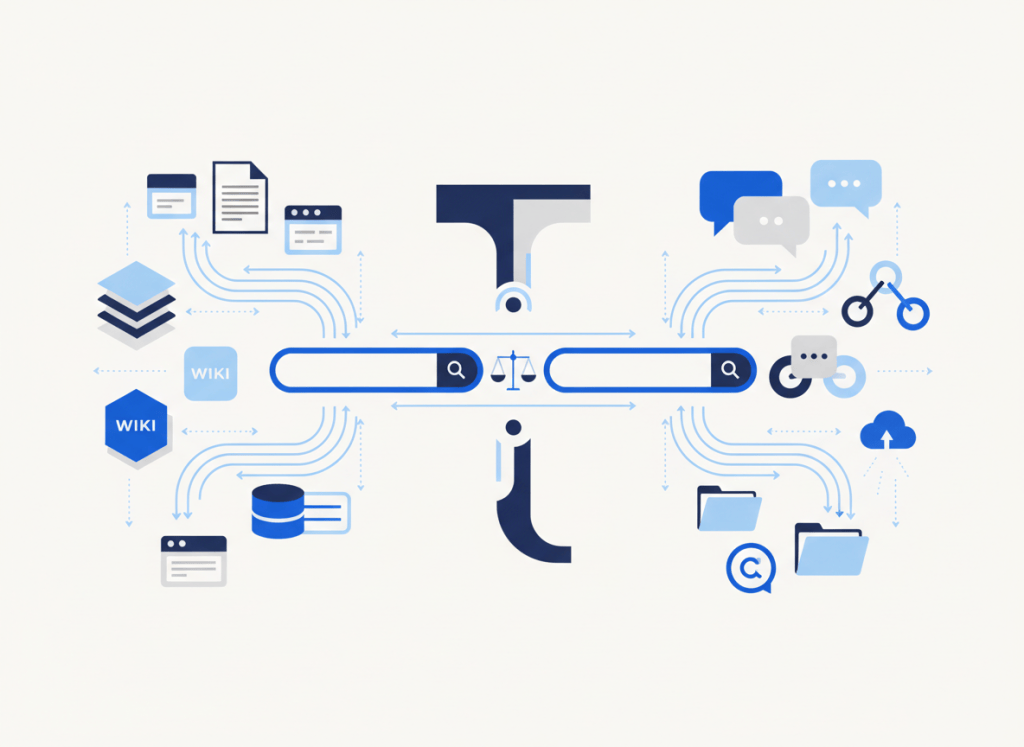
AI search is turning collaboration software into something broader than a place to store documents or send messages. Notion and Slack can now search across information that lives outside their own products, which creates a practical question for teams already paying for several work apps: where should company knowledge search actually live?
The answer depends less on which AI sounds smarter and more on where your team’s useful context is created. Notion starts from structured workspace knowledge. Slack starts from conversations and the flow of daily work. Both are expanding beyond those starting points.
Notion AI vs Slack Enterprise Search at a glance
| Decision factor | Notion AI | Slack Enterprise Search |
|---|---|---|
| Natural center of gravity | Docs, wikis, databases, projects | Messages, channels, files, daily conversations |
| Connected knowledge | Can search supported connected apps such as Slack, Google Drive, GitHub, Jira, Microsoft Teams, SharePoint and OneDrive | Can search supported external sources including Google Drive, Microsoft Teams, Confluence, GitHub, Jira, OneDrive, SharePoint, Asana and Box |
| Best fit | Teams whose durable knowledge already lives in Notion | Organizations where Slack is the main entry point to day-to-day work |
| Access model | AI and connected-search capabilities depend on the Notion plan and feature | Cross-app enterprise search is positioned as an Enterprise+ capability |
This is not a perfect feature-for-feature comparison. The products have different plan structures and broader purposes. The useful comparison is whether either one can become the front door to knowledge your team already has.
Notion is strongest when knowledge is meant to become durable
Notion’s basic advantage is structural. A decision can become a page. A project can have a database. A process can become a wiki entry. Information is not only retrieved; it can be organized into a workspace designed to remain useful after the original conversation ends.
Notion AI extends search beyond that workspace. Notion documents connected search across sources including Slack, Google Drive, GitHub, Jira, Microsoft Teams, SharePoint and OneDrive, with access respecting the permissions available through those connections.
That makes Notion increasingly relevant even when not all company knowledge originates there. A team can keep Notion as the organized layer while using connected search to reach information elsewhere.
We explored a related boundary in Notion AI vs ChatGPT Business for team knowledge, where the main distinction is between AI embedded in a workspace and a general AI assistant connected across company tools.
Slack starts where work is discussed
Slack has a different source of context. Questions, quick decisions, links, files, status updates and informal explanations often appear in channels before anyone turns them into formal documentation.
Enterprise search aims to make that conversational layer a gateway to information beyond Slack as well. Slack lists external sources including Salesforce, Google Drive, Microsoft Teams, Confluence, GitHub, Jira, OneDrive, SharePoint, Asana and Box among its supported enterprise-search connections.
For an organization that already lives in Slack throughout the day, this can reduce the need to leave the conversation layer just to find context. The trade-off is that retrieval does not automatically solve the underlying knowledge-management problem. A useful answer found in a channel can still remain a transient conversation unless the team turns it into durable documentation.
Ask where the answer was created
A simple way to choose between these approaches is to look at ten questions your team repeatedly asks.
If the answers usually live in specifications, project pages, databases, process documents or a maintained wiki, Notion has a natural advantage as the search home. If the most valuable context is buried in project channels, expert discussions, shared links and message history, Slack may be the more natural starting point.
Most teams will have both. The goal is not to force every piece of knowledge into one application. It is to decide which interface employees should try first and which information deserves to be promoted from conversation into durable documentation.
Connected search does not remove permission complexity
Cross-app search sounds like a single universal index, but company knowledge is constrained by access controls. Connected systems contain private channels, restricted documents, project permissions and information intended for different groups.
That makes permission behavior part of the product decision, not a technical footnote. Before rolling out company-wide AI search, test representative users with different access levels and confirm what they can retrieve from each connected source.
Do not buy two search layers without defining their jobs
The more AI search becomes standard inside productivity software, the easier it is to pay several vendors for overlapping retrieval capabilities.
A team might have AI search in Notion, Slack, a general AI assistant, a project-management platform and its cloud office suite. Each can be useful, but overlap becomes expensive when nobody knows which one is supposed to answer which kind of question.
Before adding another AI search subscription, use the process in our AI productivity stack audit to identify duplicate capabilities and decide which application owns each workflow.
The surrounding workspace still matters
Search is only one layer of the decision. If Notion is also where your team writes documentation, manages projects and maintains databases, its search has more opportunities to turn an answer into ongoing work. Our Notion vs ClickUp guide looks more broadly at how workspace structure changes the fit for small teams.
Likewise, adding more AI features should not automatically mean adding more tools. The AI productivity stack guide explains why it is usually better to assign clear roles to a smaller set of products than to collect overlapping assistants.
The bottom line
Choose the search home that matches where your team’s most valuable knowledge is created and maintained.
Notion AI is a natural fit when structured documentation, project context and maintained workspace knowledge are central to how the team operates. Slack Enterprise Search is a natural fit when conversations are the primary interface for daily work and the organization wants that interface to reach across other knowledge systems.
Neither choice eliminates the need for knowledge hygiene. AI can make scattered information easier to retrieve, but teams still need to decide which decisions should become durable documentation, who owns it, and where people should look first.

Leave a comment