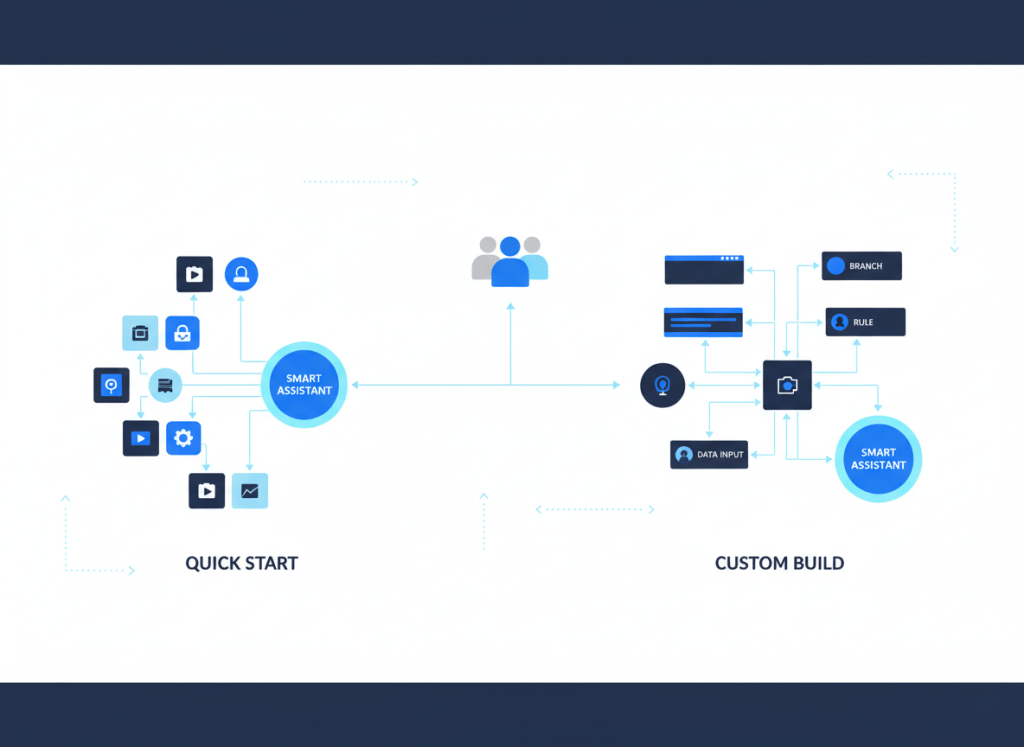
Zapier Agents and Make AI Agents are moving toward the same broad idea: give an AI system access to business context and tools, then let it decide how to complete part of a workflow. But the surrounding platforms still reflect different approaches to automation.
For a small team, that matters more than a checklist of agent features. The real choice is whether you value a large integration ecosystem and a relatively direct path into agent building, or a visual automation environment where agent reasoning sits alongside detailed workflow logic.
Zapier Agents vs Make AI Agents at a glance
| Decision factor | Zapier Agents | Make AI Agents |
|---|---|---|
| Platform approach | Agent building inside Zapier’s broad automation ecosystem | Agents inside a visual scenario-building environment |
| Integration emphasis | Zapier advertises 9,000+ app integrations | Make advertises 3,000+ pre-built apps |
| Workflow visibility | Agent-focused setup with connected tools and actions | Strong visual emphasis on scenarios, branches, logic, and agent steps |
| Best fit | Teams prioritizing app coverage and a direct route to connected agents | Teams wanting granular visual control around agentic and deterministic steps |
| Usage model | Agent plans use activity allowances | Usage sits within Make’s credit-based platform model |
Those usage models are not directly equivalent, so a headline price comparison can be misleading. Estimate the workflows you actually expect to run before treating either platform as cheaper.
Zapier starts with ecosystem breadth
Zapier’s long-standing advantage is the size of its integration catalog. The company currently advertises more than 9,000 app integrations across its automation platform. That breadth matters when an agent needs to act across the SaaS tools a small team already uses.
Zapier Agents lets users connect tools and knowledge to an agent, define what it should do, and let the agent perform activities through those connections. The appeal is straightforward: if your existing stack is already well covered by Zapier, the agent layer can build on that connectivity rather than requiring a separate integration system.
At the time of writing, Zapier lists a free Agents tier with 400 activities per month and a Pro tier at $33.33 per month when billed annually with 1,500 activities per month. Pricing and allowances can change, so verify current terms before budgeting around those figures.
Make puts the agent inside a visual workflow system
Make approaches agents through the visual automation model its users already know. AI Agents can participate in scenarios alongside conventional modules, routing, conditions, and other deterministic workflow components.
That is useful when the team does not want an agent to own the entire process. A scenario can keep predictable steps explicit while reserving AI reasoning for the point where context has to be interpreted or the next action cannot be fully predetermined.
Make also emphasizes visibility into how an agent reasons and acts inside the canvas, and its agent workflows can include human approval where appropriate. The platform currently advertises more than 3,000 pre-built app integrations.
Do you actually need an agent?
Before comparing these products, make sure the workflow needs agentic behavior at all.
If the trigger, rules, and outcome are predictable, ordinary automation will usually be easier to test and operate. If only one step requires interpreting unstructured information, a normal workflow with an AI step may be enough. An agent becomes more useful when the system genuinely has to inspect context and choose what to do next.
Our AI Agent vs Automation decision framework walks through that distinction before you commit to an agent platform.
Choose based on the workflow around the agent
The strongest reason to consider Zapier is not that its agent is universally better. It is that Zapier offers a very broad set of app connections and a familiar automation environment for teams that want to get an agent working across existing SaaS tools without designing an elaborate scenario first.
The strongest reason to consider Make is not simply that its canvas looks more technical. It is that teams can make the surrounding workflow explicit: where deterministic logic runs, where the agent is allowed to reason, how branches behave, and where a human should approve an action.
This is the same underlying trade-off visible in the broader Zapier vs Make vs n8n comparison. Agent features add a new layer, but they do not erase the design philosophy of the automation platform underneath.
Pricing needs a workload, not just a plan page
Agent pricing is unusually easy to compare badly. Zapier Agents measures plan allowances in activities. Make’s broader platform uses credits, and AI-related consumption can depend on the modules, models, and operations involved in a scenario.
Instead of asking which subscription has the lower monthly number, model one real workflow. Estimate how often it runs, how many actions or operations it performs, how much AI reasoning it invokes, and how often a person has to correct or approve the result.
A cheap agent that needs constant supervision is not necessarily inexpensive. A more controlled workflow that uses AI only where uncertainty exists can be easier to budget and debug.
Small teams should keep the first agent narrow
Whichever platform you choose, start with a workflow that has a clear source of truth and a reversible output. Researching information and drafting an internal update is safer than autonomously sending consequential external messages. Classifying an incoming request is safer than deciding its business priority without review.
For examples of deliberately narrow agent jobs, see our five Notion Custom Agent workflows for small teams. The product is different, but the design principle is the same: constrain the job before expanding autonomy.
Avoid paying for overlapping AI layers
One more issue matters for small teams: agent functionality is spreading across automation platforms, project tools, email clients, knowledge systems, and general AI assistants.
If you already pay for several of those layers, define what the automation platform’s agent uniquely owns. Our AI productivity stack audit can help identify duplicated capabilities before another subscription becomes permanent.
The bottom line
Zapier Agents and Make AI Agents can both connect AI reasoning to real business tools, but they arrive there through different automation environments.
Zapier is compelling when integration breadth and a direct path to connected agent actions are priorities. Make is compelling when the team wants to see and shape the surrounding workflow in detail, mixing agent decisions with explicit rules, branches, and approvals.
Do not choose on the agent label alone. Map one real process, identify exactly where judgment is required, and compare how clearly each platform lets you control everything around that judgment.

Leave a comment