Shortwave and Superhuman Mail both promise to make email faster with AI. For a small team already using Gmail, however, the more useful question is whether either product improves the inbox enough to justify another paid layer in the work stack.
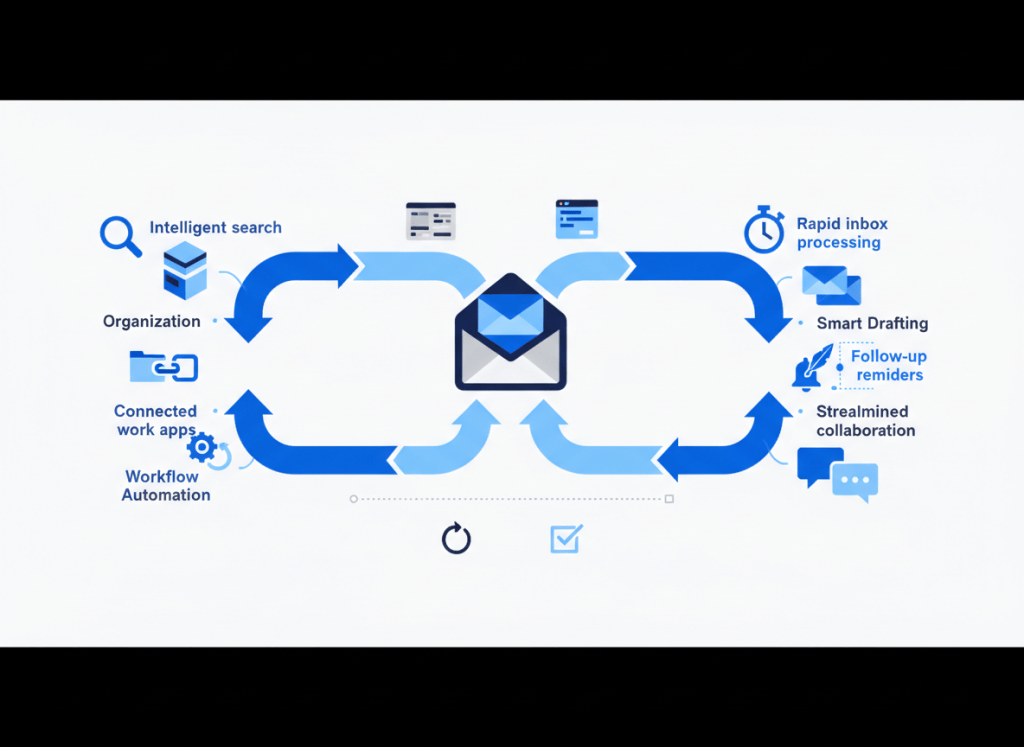
The two products overlap in AI writing, search, organization, and productivity features, but their emphasis is different. Shortwave leans toward turning Gmail into a more connected, AI-searchable work surface. Superhuman Mail puts more weight on moving through the inbox quickly, drafting and following up efficiently, and collaborating around email.
That makes this less of a feature-count contest and more of a workflow decision.
Shortwave vs Superhuman Mail at a glance
| Decision factor | Shortwave | Superhuman Mail |
|---|---|---|
| Core fit | AI-powered Gmail workspace with search, organization, and connected context | Fast email workflow with AI drafting, organization, follow-up, and collaboration |
| Email foundation | Built around Gmail / Google Workspace | Supports Gmail and Outlook-based workflows |
| AI emphasis | Search, writing, filters, automation, connected work context | Ask AI, Auto Drafts, Labels, Reminders, writing and inbox assistance |
| Team angle | Team management, centralized billing, collaboration features | Shared Conversations, Team Comments and broader Superhuman suite context |
| Best reason to pay | You want email to connect more deeply with knowledge and workflow | You want a highly optimized email-processing experience |
If you are also considering whether a separate AI email app is necessary at all, start with our broader Gemini in Gmail vs Shortwave vs Superhuman Mail comparison. This guide assumes you have already decided that Gmail’s built-in AI layer may not be enough.
Shortwave treats the inbox more like a connected workspace
Shortwave is an AI email client built around Gmail. Its value proposition extends beyond composing replies: it combines AI search and writing with inbox organization, custom AI filters, and connections to other work tools.
Shortwave can connect context from services including Google Calendar, Slack, Notion, and Asana. That matters if email is one of several places where your team has to retrieve information before answering a customer, vendor, or colleague.
For that kind of team, the attraction is not simply “AI writes email.” It is reducing the distance between a message and the information needed to handle it.
Superhuman Mail optimizes the act of processing email
Superhuman Mail has long centered its product around a fast, deliberate inbox workflow. Its current AI features extend that model with tools such as Ask AI, Auto Drafts, Labels, and Reminders.
The product also includes collaboration features such as Shared Conversations and Team Comments, which can reduce the need to forward messages or move every email discussion into another communication tool.
The distinction is subtle but important. Shortwave increasingly makes email a place to search and connect work context. Superhuman Mail makes the mechanics of reading, responding, organizing, and following up on email more efficient.
The Gmail dependency may decide the comparison early
Shortwave is fundamentally a Gmail product. If your organization is committed to Google Workspace, that focus can be an advantage because the product is designed around that ecosystem.
If your team needs Outlook support or expects email infrastructure to change, Superhuman Mail has a broader fit. Before comparing advanced AI features, confirm that the underlying account and administrative requirements match your organization.
Compare AI by the work around the message
AI writing is becoming a weak differentiator on its own. Gmail itself can draft and summarize, and general-purpose AI tools can help with writing too.
A paid email client has to solve more of the surrounding workflow. Ask what happens before and after the reply: finding an old decision, retrieving project context, organizing incoming messages, remembering a follow-up, collaborating with a teammate, or turning the message into work somewhere else.
If your team is accumulating several overlapping AI subscriptions, use our AI productivity stack audit before adding another one.
Shortwave makes more sense when context retrieval is the bottleneck
Consider Shortwave when your team lives in Gmail and repeatedly has to search for information before acting on messages.
Its combination of AI search, inbox organization, filters, and connected work context is most relevant when the problem is not simply the number of emails. The problem is that each email sends someone hunting through other tools for the answer.
That can be particularly useful for small teams where customer conversations, project information, scheduling, and internal knowledge are spread across a handful of SaaS tools.
Superhuman Mail makes more sense when inbox throughput is the bottleneck
Consider Superhuman Mail when email itself is a major daily work surface and the team values a highly optimized process for triage, drafting, reminders, follow-up, and collaboration.
Its appeal is stronger when shaving friction from repeated email actions matters more than turning the inbox into a broader connected knowledge layer.
That distinction is worth testing against actual team behavior. A sophisticated email client will not create much value for employees who only handle a modest number of consequential messages each day.
Pricing needs to be evaluated at the stack level
Both products offer paid plans, and their packaging has evolved as AI features have expanded. Superhuman is also positioning Mail within a broader Superhuman product suite, while Shortwave offers plans aimed at individuals and teams with different AI and administrative capabilities.
Because plan names, limits, AI usage, and suite packaging can change, verify current pricing on the vendors’ official pricing pages before purchasing. More importantly, calculate cost against tools the product might replace rather than treating the email subscription in isolation.
A $20 or $30 software decision is very different if it eliminates another workflow tool for every user. If it merely duplicates AI writing already available elsewhere, the same subscription is harder to justify.
Do not migrate the whole team first
Email habits are unusually personal. A workflow that feels dramatically faster for a founder, salesperson, recruiter, or customer-success lead may add little value for someone whose work is mostly project-based.
Start with the people who have the clearest email bottleneck. Define what should improve, such as time spent searching for context, missed follow-ups, repetitive drafting, or inbox triage. Then decide whether the improvement is meaningful enough to justify expanding the paid seat count.
This role-based approach is consistent with the broader AI productivity stack framework: buy tools for a defined job in the workflow, not simply because the AI feature list is impressive.
The bottom line
Shortwave is the more natural direction for Gmail-centric teams that want AI search, organization, and connected work context to live closer to the inbox. Superhuman Mail is the more natural direction for teams that place a premium on a fast, refined email-processing workflow with AI and collaboration built around it.
Neither is automatically worth paying for just because it has more AI than a standard inbox. The case becomes stronger when the product removes a specific, expensive source of friction that your existing Gmail or Outlook workflow does not solve.

Leave a comment